The global semiconductor industry is characterised by diversity. Markets and economies vary depending on the domain in which they excel. On one side there is Europe's manufacturing-heavy, design-light semiconductor industry with the design-dominant United States. But the other hemisphere holds different production logic and carries most of the world's actual chip manufacturing weight. Taiwan, South Korea, Japan and Singapore - each has built a distinct specialisation: memory, foundry manufacturing, components, or advanced packaging and R&D. Together they represent a model built less on chip design and more on unmatched, state-backed manufacturing scale.
Four different specialisations
Taiwan
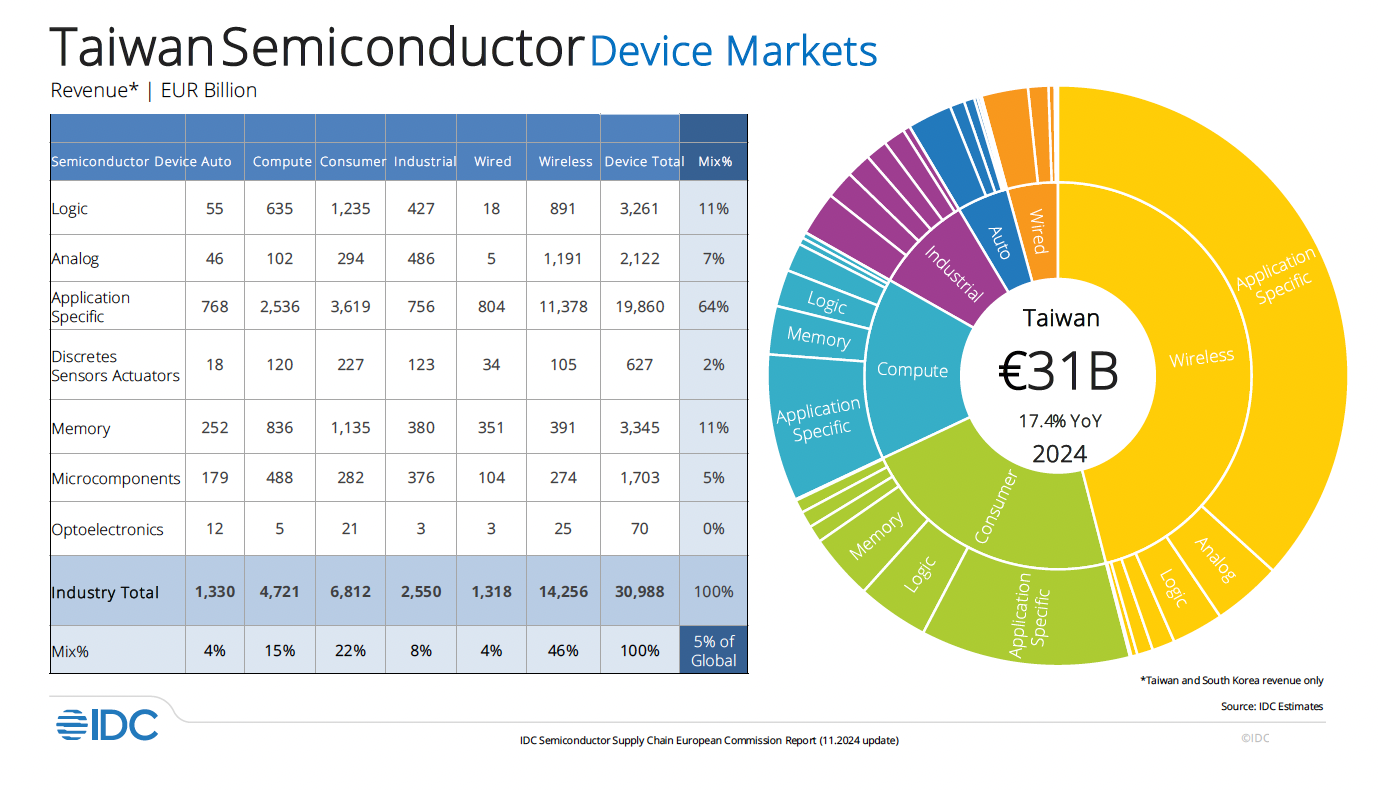
Companies headquartered in Taiwan generated around €31 billion in revenue in 2024, about 5% of the global semiconductor market. That figure, however, covers only what Taiwan-headquartered companies design and sell directly. It excludes Taiwan's foundry industry, led by TSMC, which manufactures chips designed by companies elsewhere in the world. When it comes to Taiwan's own device revenue, wireless applications are the largest end market at 46%, followed by consumer electronics at 22% and computing at 15%.
IDC report, page 35.
South Korea
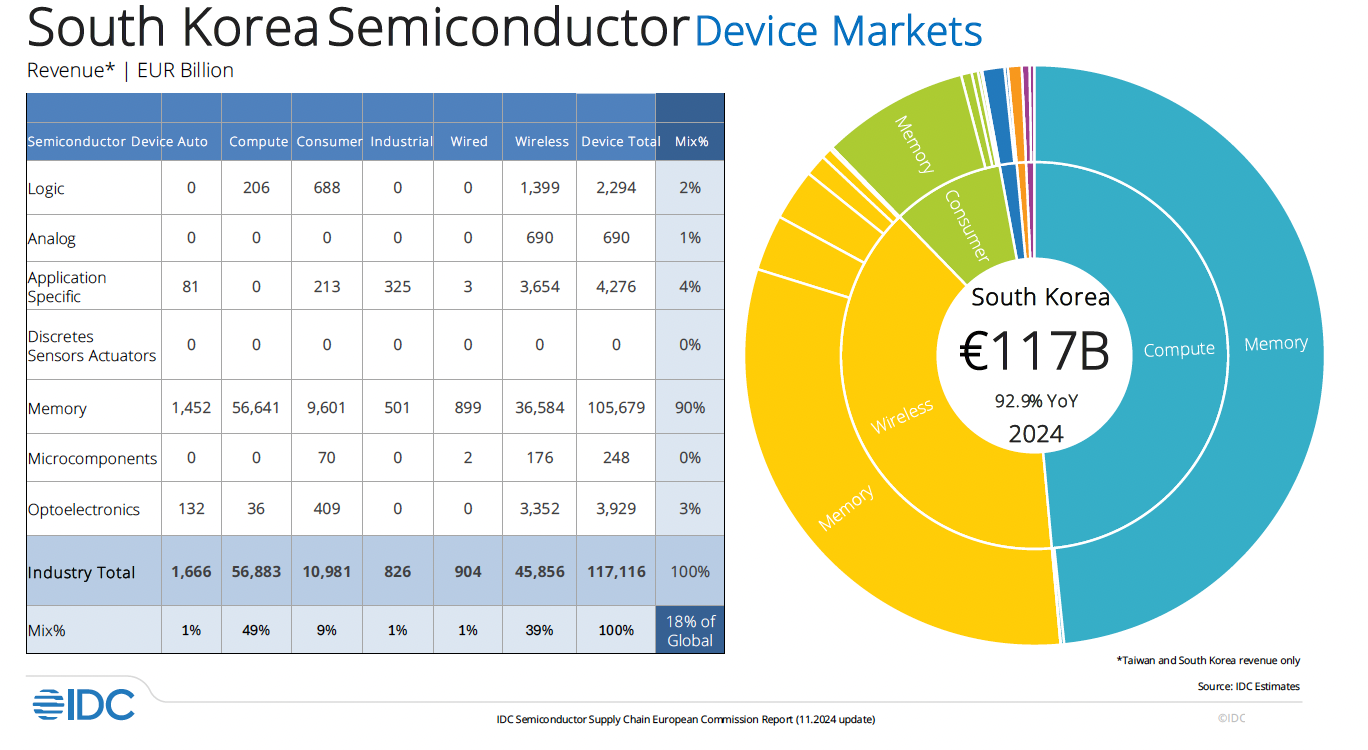
Companies headquartered in South Korea generated around €117 billion in revenue in 2024, roughly 18% of the global semiconductor market. That’s more than double what they recorded just a year earlier. That surge was driven almost entirely by the rebound in memory, particularly high-bandwidth memory linked to the buildout of AI servers and data centres, a segment where South Korea's industry has long been concentrated. Memory now accounts for the overwhelming amount of the country's semiconductor revenue, with computing and wireless applications standing out as the main markets it serves. Samsung and SK Hynix remain the two companies driving that performance.
IDC report, page 36.
Japan
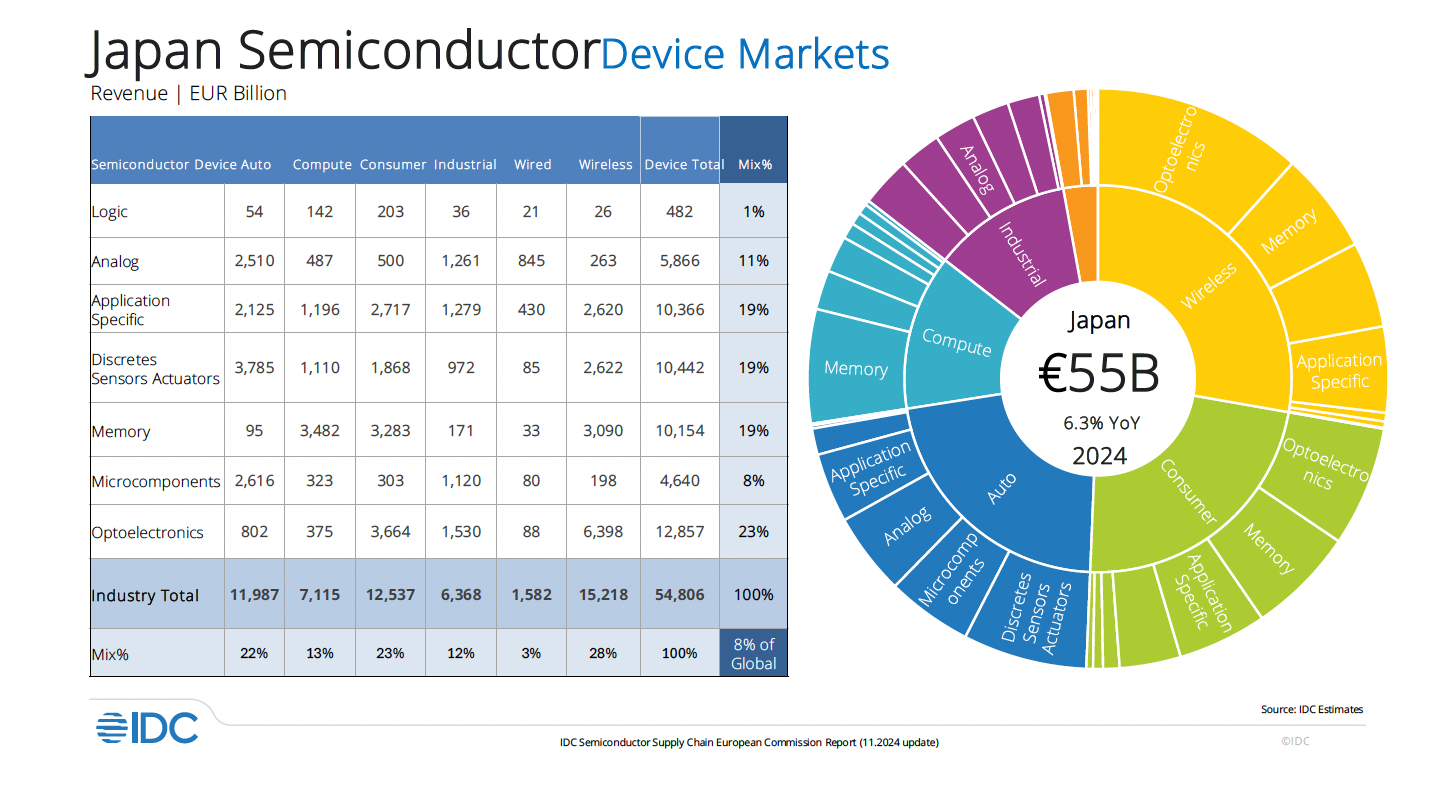
Companies headquartered in Japan generated around €55 billion in revenue in 2024, or roughly 8% of the global semiconductor market. That share has been slipping for some time — down from about 10% in 2023 and well below the 12% Japan held in 2020 — even though the absolute revenue figure has held up reasonably well. Automotive and wireless applications remain Japan's largest end markets, and Japanese companies continue to hold a particularly strong position in optoelectronics, discrete devices, sensors and actuators, reflecting a long-standing industrial strength that predates the current AI-driven cycle.
IDC report, page 34.
Singapore
Singapore shows us something different. No Singapore-headquartered company is large enough to appear as its own line in the device-revenue tables, and this reflects a genuine strategic choice rather than an oversight. Rather than building national champions to rival Taiwan's foundries or South Korea's memory makers, the city-state has cultivated a narrower but no less valuable role as a trusted hub for manufacturing, logistics, assembly and test, and research and development. Recent developments demonstrate this well. Under its RIE2030 plan, unveiled in late 2025, the government named semiconductors a priority sector and backed that commitment with a substantial new research budget, while ongoing fab expansions from VSMC and UMC, together with a major long-term investment from Micron, suggest that Singapore's manufacturing base continues to deepen even without design companies of its own.
Where the real scale is: manufacturing
None of the device-revenue figures discussed above capture what may be the more important fact about this group of economies: together, they carry out most of the world's actual chip production. Taiwan and South Korea alone account for the overwhelming majority of the global merchant foundry market — the business of manufacturing chips designed by companies elsewhere — leaving little space for other producers to compete at scale. The same imbalance shows up in wafer manufacturing capacity more broadly. Taiwan, South Korea and Japan together account for close to half of the world's monthly wafer output, even before China's own considerable share enters the picture. The EU27 and the United States, by comparison, each hold only a modest fraction of that capacity. This is a reminder that however strong Europe's position may be in equipment, materials or specialised chip segments, it remains, in manufacturing terms, a relatively minor player on the global stage.
What this means for Europe
If the comparison with the United States exposed a design gap, the comparison with Asia exposes something more fundamental —a gap in scale. Under its Digital Decade agenda, Europe has set itself the ambitious goal of reaching a fifth of world semiconductor production in value by 2030. Yet on IDC's current projections, the EU27's share of global manufacturing capacity is heading in the wrong direction. It is expected to shrink further over the coming years, weighed down by delayed investment projects in Germany and Poland, even as Taiwan, South Korea and Japan largely hold their ground. Europe's position in foundry manufacturing specifically remains thinner still, amounting to only a marginal share of a market that Taiwan and South Korea between them dominate almost entirely.
Unlike the United States, which leverages a fabless model to lead in high-value design, the Asian Tigers arrived at their position by the opposite route: concentrated, state-backed investment in a handful of flagship manufacturers such as TSMC, Samsung, SK Hynix and Rapidus, or, in Singapore's case, by attracting foreign capacity rather than cultivating champions of its own. Europe has neither the design dominance of the US nor the manufacturing scale of Asia. Its genuine leverage lies instead in the segments where it already leads, such as equipment, materials, and automotive- and industrial-grade chips; while its first-of-a-kind projects, from ESMC in Dresden to Silicon Box in Novara, FAMES and NanoIC, offer at best an early foothold in a game of scale the Asian Tigers appear to have already won.
In our next and final article in this series, we'll look at what a realistic path to European semiconductor competitiveness could look like, including the report's own revised targets and roadmap for the years ahead.
