The production of chips and semiconductors is a complex process that requires many actors and components dispersed across the globe. As chips and semiconductors continue to be strategically relevant, the importance of understanding how the value chain functions and where countries and regions position themselves within it has become a strategic necessity.
This article opens a new series examining Europe’s position across the semiconductor value chain and market. Drawing on the latest analysis from IDC, the series will follow market developments and several leading done for the countries' positions, advancements and strategies in the chip race.
For the European Union, this question of positionality has become particularly important. The EU set the ambitious goal of reaching 20% of the global semiconductor market by 2030, while the European Chips Act provides a framework for strengthening Europe’s semiconductor ecosystem and supporting new investments. But where does Europe hold power in the global semiconductor value chain, where is it dependent on others, and what does it need to do to remain strategically relevant?
According to the 2026 IDC report written for the European Commission, the answer starts with understanding that semiconductor power is about much more than simply manufacturing chips. The value chain stretches from semiconductor intellectual property and electronic design automation to materials, manufacturing equipment, fabrication, assembly, packaging and testing. It is a deeply interconnected global ecosystem, designed over decades to minimise costs and accelerate time to market. However, with more efficiency comes more dependencies. The globalised market susceptibility to disruptions has forced countries to diversifying supply chains and reducing excessive dependence on particular Asian production hubs.
According to the report, Europe is far from absent from the semiconductor race. It has important capabilities in areas such as semiconductor capital equipment, as well as strong positions connected to the automotive and industrial semiconductor markets. These are significant strategic assets within a value chain in which no single region controls every stage.
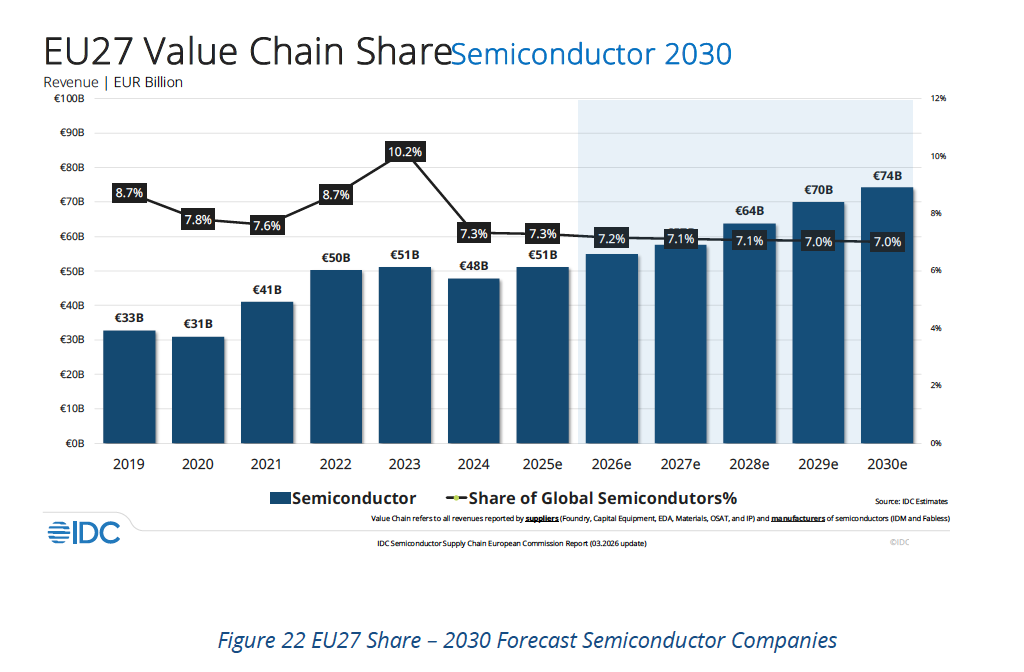
Nevertheless, Europe's relative position has recently weakened. EU-headquartered companies accounted for 10.1% of worldwide semiconductor production in 2023, but only 7.3% in 2024. By comparison, companies headquartered in Taiwan, Korea, China and Singapore represented around 29% of worldwide production in 2024.
IDC report, page 50.
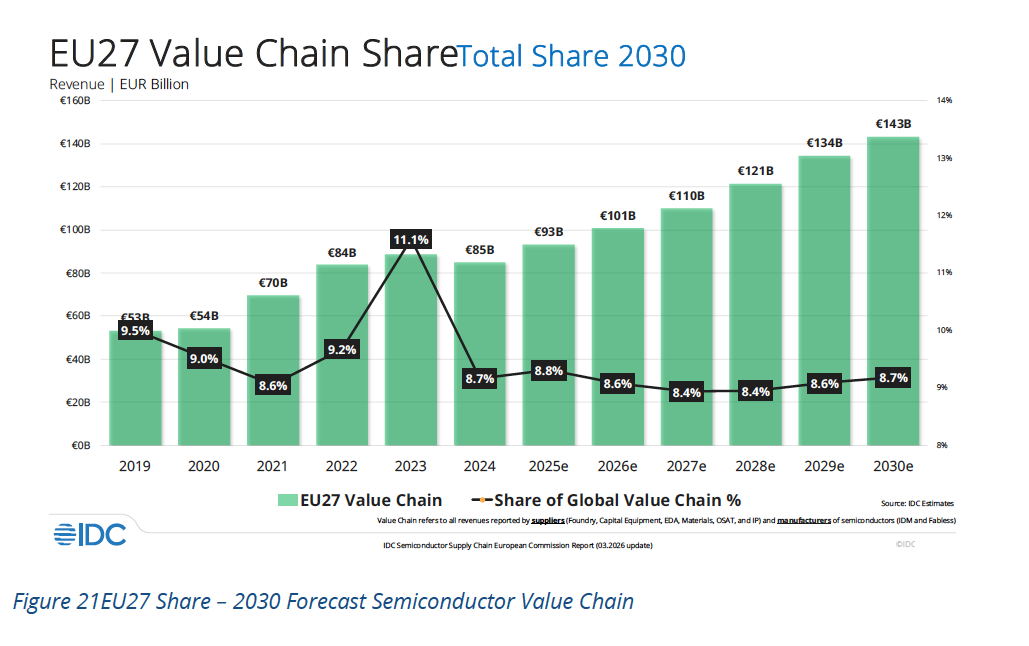
The same pattern can be seen across the broader value chain. EU semiconductor manufacturers and supply-chain companies together represented 11.1% of global semiconductor value-chain revenue in 2023, falling to 8.7% in 2024.
IDC report, page 48.
In other words, Europe’s semiconductor ecosystem is growing, but the global market is growing faster particularly as AI and computing increase the weight of areas dominated by non-European companies.
From a 20% ambition to a more realistic strategy
While the original Digital Decade goal envisaged Europe reaching 20% of the global semiconductor market by 2030, IDC argues that current developments make this increasingly unrealistic as a working target. Based on current Digital Decade monitoring and recent assessments, the report points towards approximately 11.7% of the global semiconductor value chain by 2030. IDC therefore proposes treating 11.5–12% as a realistic operational benchmark, while retaining the 20% goal as a longer-term political ambition. As some projects are being postponed and others are progressing, navigating the curvy trajectory of the value chain impact growth and maintaining Europe's relevance will require a broader strategy. This would entail developing a portfolio of realistic investments across mature, specialty and selected advanced semiconductor segments, while strengthening the infrastructure, skills and predictable public support required to sustain them.
The semiconductor race, therefore, is not simply a race for more fabs or a bigger percentage of global production. The real name of the game is strategic positioning across an interdependent global value chain.
In the upcoming articles, we will use IDC's analysis to look more closely at where Europe leads, where dependencies are greatest, how different countries are navigating their positions and where new industrial opportunities could emerge.
