
Across this IDC report-based series, we've compared Europe's semiconductor industry with the design-dominant United States and with the manufacturing scale of Taiwan, South Korea, Japan and Singapore. Both comparisons point to the same underlying question — how much of the global chip supply chain can Europe realistically expect to hold, and what would it take to get there? In its closing chapter, the IDC report answers that question directly and, notably, revises the target it is measured against.
Both of those comparisons left little room for complacency. Against the United States, the gap was one of value. American companies capture most of global semiconductor revenue through design and intellectual property, while Europe's strength remains concentrated in manufacturing equipment, materials and automotive-grade chips rather than high-margin design wins. Against Taiwan, South Korea, Japan and Singapore, the gap was one of scale: those four economies alone account for the overwhelming majority of the world's actual chip manufacturing capacity, built on decades of concentrated, state-backed investment that Europe has never matched. Read together, the two comparisons anticipate the conclusion this closing chapter now makes explicit - closing either gap on the timeline and scale implied by a 20% by 2030 target was never realistic, and Europe's real opportunity lies in a narrower, better-financed ambition.
A more honest number
For years, EU policy has been built around a single headline figure: the Digital Decade ambition of reaching 20% of world semiconductor production in value by 2030. IDC's final report treats that number differently. Drawing on the European Commission's own Digital Decade monitoring and a recent European Court of Auditors assessment, it concludes that a realistic 2030 benchmark is closer to 11.7–12% of the global value chain, with the original 20% retained only as a longer-term political aspiration rather than a working target for this decade. Looking further out, the report proposes a new interim milestone of 14–15% by 2035.
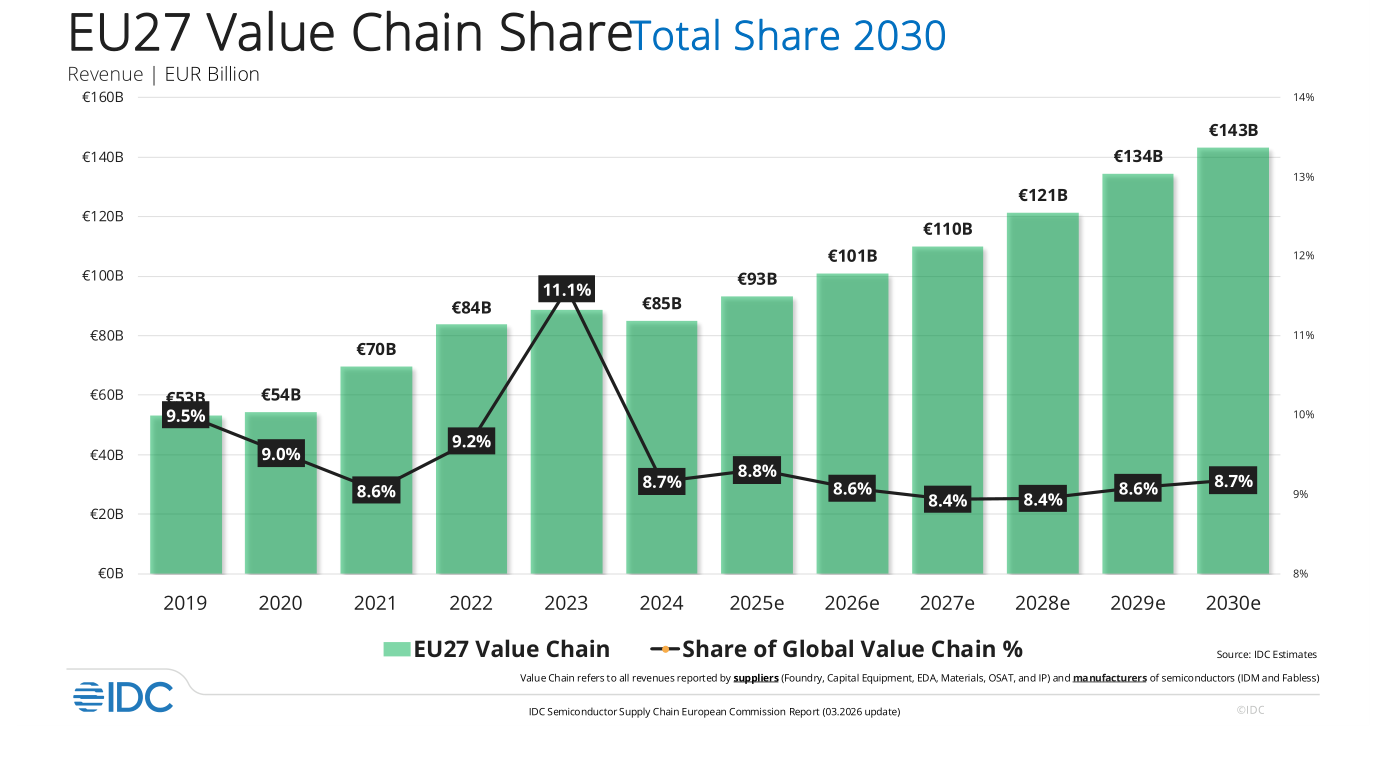
IDC report, page 48.
Why the ambition was rewritten
The recalibration is not a verdict on the Chips Act itself. IDC is explicit that the Act has generated new momentum, new pilot lines, competence centres, and greater political visibility for semiconductors than the sector had before. The problem, in the report's own words, is that the original 20% target was set against a more favourable project pipeline than the one that has actually materialised; several flagship investments once expected to transform Europe's manufacturing outlook, including Intel's plant in Magdeburg and the Wolfspeed project in Ensdorf, have since been postponed or cancelled. Europe also simply needs more capital to build the same capacity as its competitors. IDC estimates that a euro of capex spent on a fab in Taiwan or Japan buys roughly 45% more capacity than the same euro spent in the EU, largely due to higher construction, energy, compliance and ecosystem costs.
What it would take to reach the goal
Reaching even the recalibrated target is not a passive exercise. IDC estimates that Europe would need to mobilise on the order of €120–140 billion in total policy-driven investment by 2030, including a further €15–25 billion in fresh public funding to protect the current project pipeline and crowd in an additional €30–40 billion of private capital. A second wave of similar scale, roughly €30–40 billion in public support and €60–80 billion in private co-investment, would be needed between 2031 and 2035 to move from around 12% toward the 14–15% goal. In manufacturing terms, that translates into a modest but concrete fab agenda: around four to five new fab-scale additions or major expansions by 2030, and six to eight in total by 2035 — a mix of one advanced or open-foundry anchor alongside specialty, power and packaging-focused facilities, rather than the wave of mega-fabs once imagined.
A narrower, more sequenced strategy
These recommendations should be read less like a wish list and more like a discipline. Before launching a second wave of announcements, Europe is urged to protect the projects already under way: accelerating permitting, securing utilities and maintaining investor confidence around established clusters such as Dresden, Grenoble-Crolles and Catania-Agrate. Public money should also keep flowing across the whole value chain rather than concentrating solely on front-end fabs, with the bulk of new support going to manufacturing and equipment and the remainder split across packaging, pilot lines, design enablement and workforce development. And rather than competing on subsidies alone, Europe is advised to compete on the fuller package that increasingly decides where global chipmakers choose to build, permitting speed, energy and land availability, skilled labour, and access to instruments such as IPCEIs and InvestEU.
Two further recommendations look beyond manufacturing itself. One is to use Europe's own demand as leverage, anchoring investment in high-performance computing and AI silicon through EuroHPC and the AI Continent Action Plan's AI Factories, so that European buyers help pull design and advanced-packaging capability into the region rather than simply importing it. The other is resilience: closer monitoring of mature-node oversupply from China, contingency planning for a Taiwan-related shock to leading-edge supply, and better real-time visibility into utilisation, inventories and equipment bottlenecks across the value chain.
That is a less dramatic ambition than “20% by 2030.” But according to IDC, it is more realistic and the one Europe can actually deliver because building credibility on a narrower, better-financed promise may matter more, in the long run, than chasing a bigger one it cannot keep.
