Europe and the United States are both major players in the global semiconductor industry, but they participate in the market in very different ways. While Europe has built its strength around manufacturing, automotive and industrial applications, the United States has become dominant in high-value chip design, computing and AI. The comparison reveals an important question for Europe: is producing more chips enough, or does Europe also need to capture more value from the fastest-growing spheres of the semiconductor market?
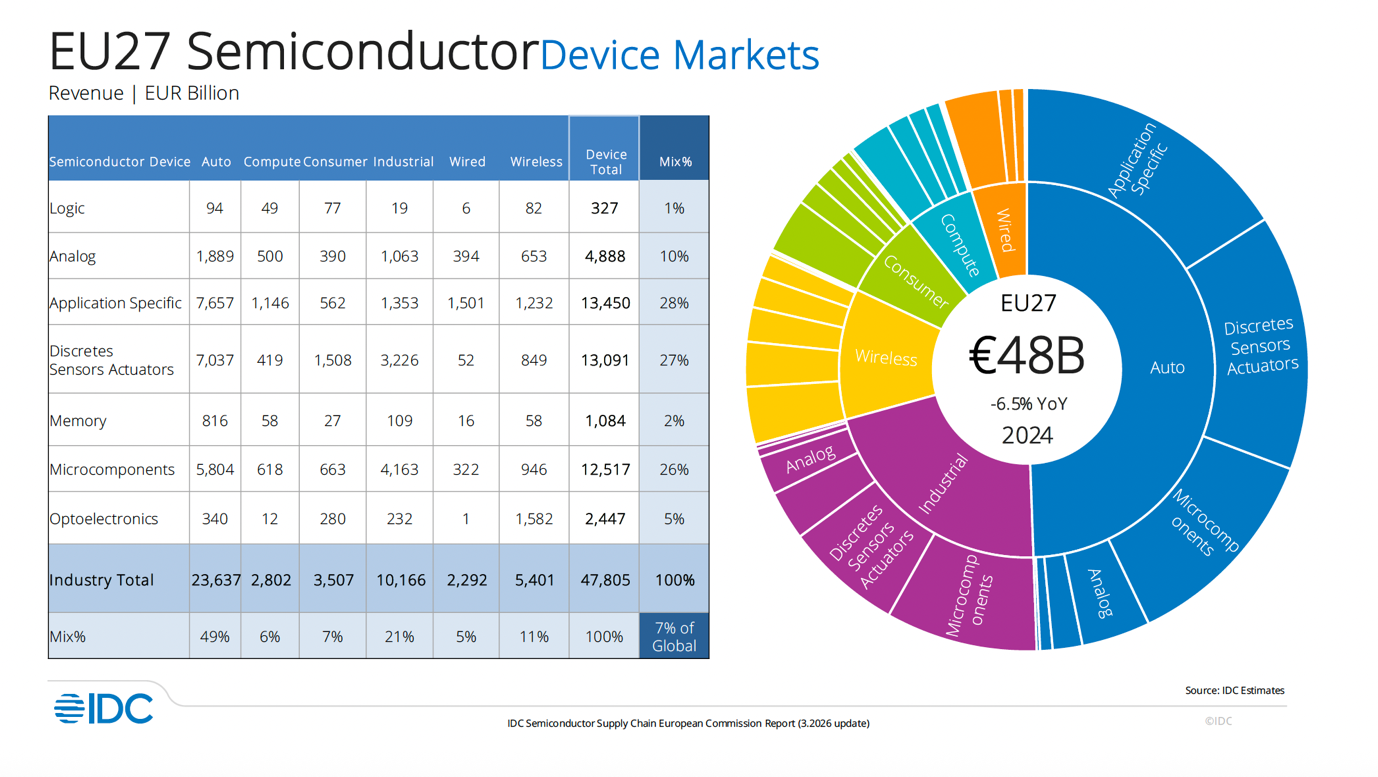
According to the IDC report, EU27-headquartered semiconductor companies generated around €48 billion in revenue in 2024, accounting for approximately 7% of the global semiconductor market.
IDC report, page 30.
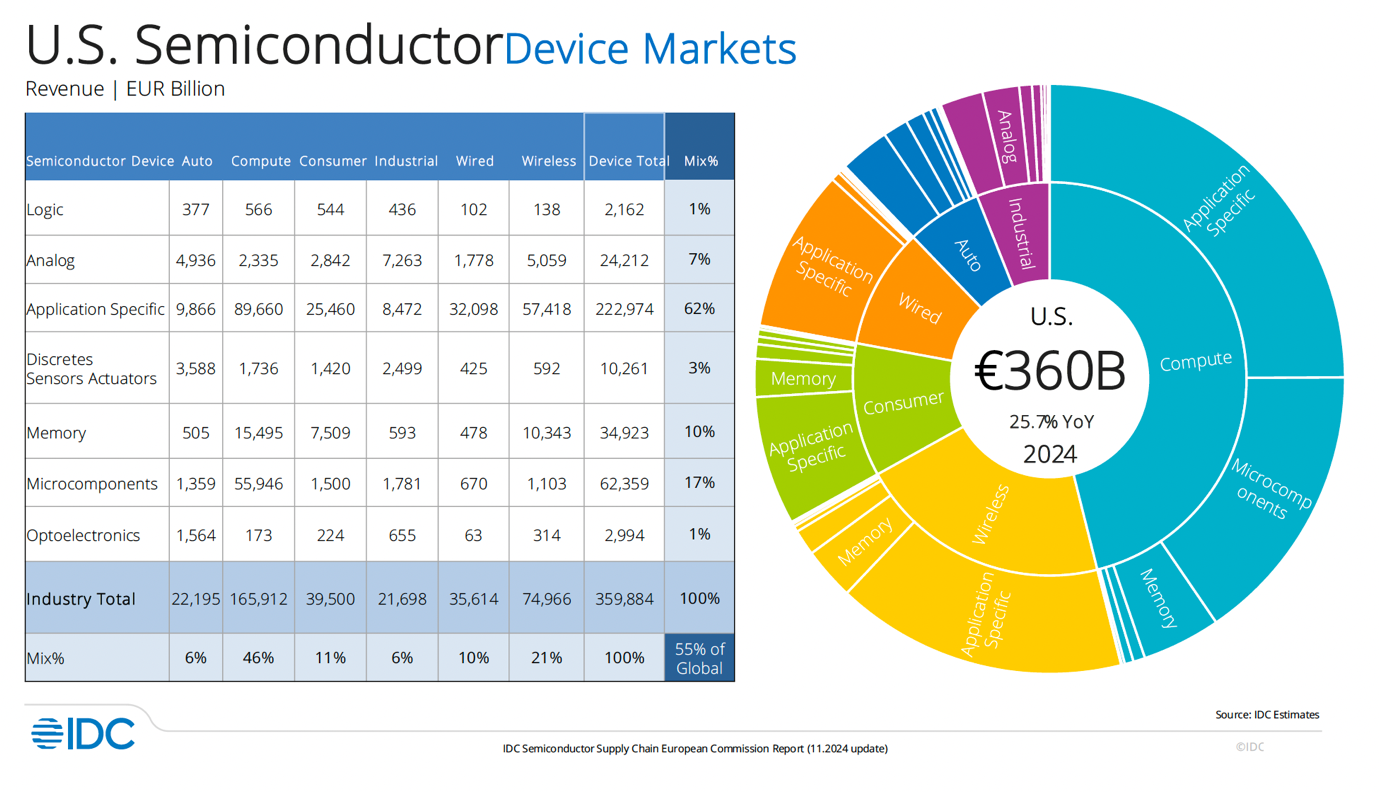
The United States, by comparison, generated around €360 billion, representing 55% of the global market.
IDC report, page 32.
The scale difference is compelling, but the numbers don’t show all there is to it. What contributes to this situation is not only how much revenue is generated, but where that revenue comes from.
Two very different semiconductor models
If we compare the two market regions, we notice the difference in their industries’ logic and infrastructure. Europe's semiconductor industry is deeply connected to its traditional industrial strengths. In 2024, around 49% of semiconductor revenue generated by EU-headquartered companies came from automotive applications, while another 21% came from industrial markets.
Over time, European semiconductor production has also shifted away from high-volume CMOS manufacturing and toward specialized technologies such as power semiconductors, analog and mixed-signal devices and MEMS sensors. Companies such as Infineon, STMicroelectronics and NXP illustrate Europe's strong position in technologies needed for cars, industrial equipment and other highly specialised applications.
The US market looks very different.
In 2024, around 46% of US semiconductor revenue came from computing, while 21% came from wireless applications. US-headquartered companies dominate areas such as processors, GPUs, AI accelerators, advanced memory and data-centre technologies.
The distinction between the two markets has become particularly important with the increasing expansion of artificial intelligence. AI is driving demand in the semiconductor segments where US companies such as NVIDIA, AMD, Qualcomm, Intel and Micron are particularly strong. As a result, AI growth while expanding the semiconductor market, also reinforces the competitive position of US companies within it.
Manufacturing vs. design
Perhaps the clearest difference between the two markets lies in the structure of their semiconductor industries. In Europe, 95% of semiconductor revenue in 2024 came from companies with their own fabrication capacity, while only 5% came from fabless companies. In the United States, the situation is almost the reverse: 64% of semiconductor revenue came from fabless companies, compared with 36% from companies with fabrication capacity.
This distinction is significant for it demonstrates how different production strategies influence market shares. The US relies heavily on fabless companies that focus primarily on designing chips while relying on external foundries for manufacturing. This model has allowed US companies to build particularly strong positions in high-value chip design, including processors, wireless technologies and AI accelerators.
On the other hand, Europe's manufacturing-oriented structure remains an important strategic asset, especially in automotive, industrial, power and analog technologies. At the same time, its relatively small fabless sector suggests that Europe has a more limited position in some of the high-growth design segments that are increasingly shaping the global market.
What does this mean for Europe?
Both regions are now investing heavily in strengthening their semiconductor ecosystems. Europe has introduced the European Chips Act (Chips Act 1.0), aimed at increasing resilience, improving security of supply and reducing external dependencies, and is now preparing a broader Chips Act 2.0 revision, expected to be proposed later in 2026. The United States has taken its own approach through the CHIPS and Science Act, combining manufacturing incentives, R&D funding and tax credits with broader trade and national-security measures.
For Europe, however, the US comparison suggests that the semiconductor challenge is not simply about increasing manufacturing capacity.
Europe already has valuable and highly specialised capabilities. The strategic question is how to preserve those strengths while also building stronger positions in chip design, R&D and emerging high-growth markets.
The semiconductor race is therefore not only about who can manufacture the most chips. It is increasingly about who captures the highest-value parts of the market and who is best positioned for the technologies driving future demand.
In the upcoming articles, we will see how Europe's semiconductor position compares with other major global markets, and what it needs to do to strengthen its competitiveness.
